
Ontario program selection guide
How to Choose an Alcohol Therapy Program in Ontario
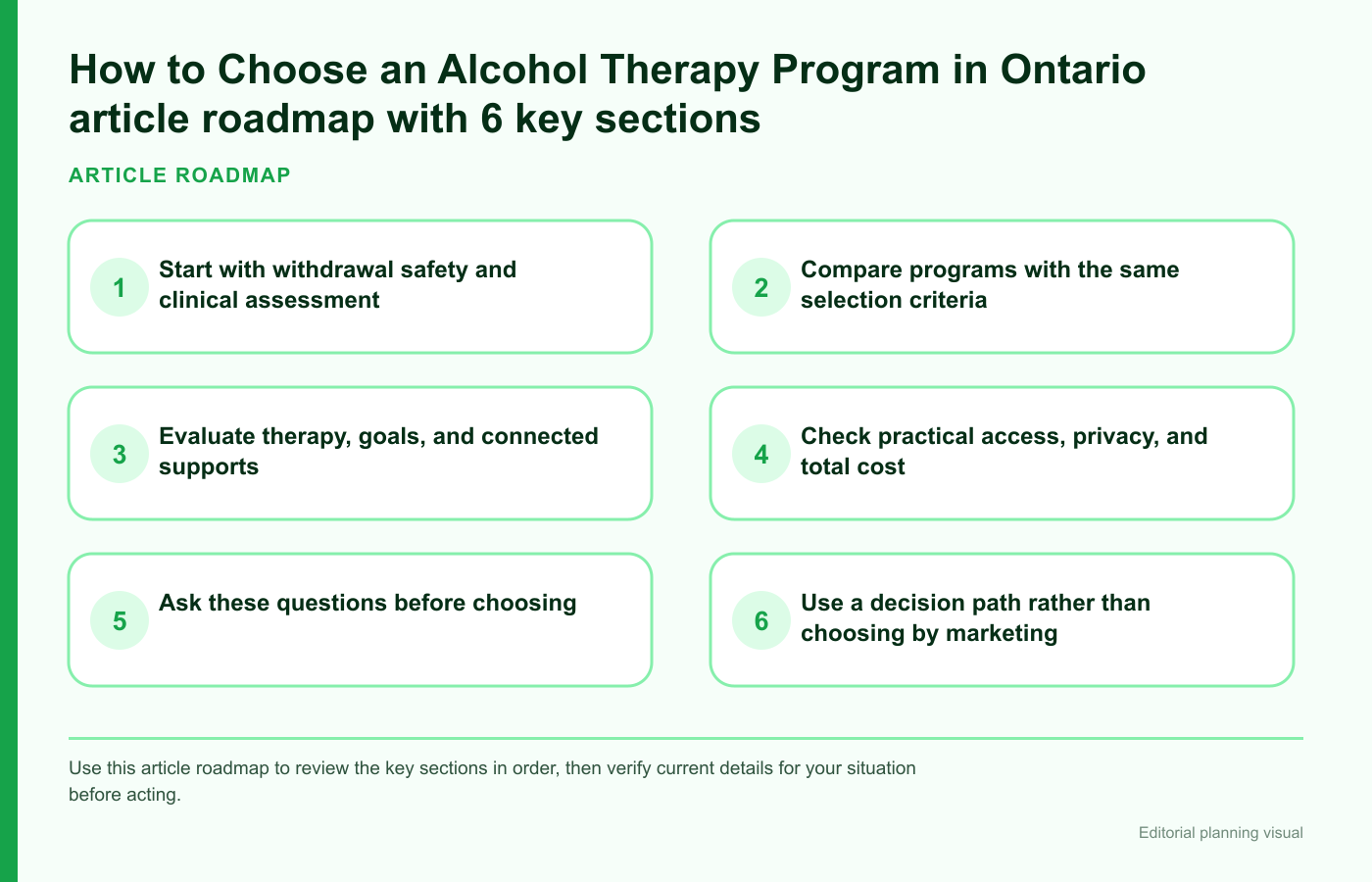
Short answer: choose an alcohol therapy program by first confirming withdrawal safety and individual assessment, then comparing qualified providers, therapy approach, mental-health and social supports, setting, privacy, access, costs, referral responsibilities, and follow-up. Verify what each program actually delivers instead of relying on the program name alone.
Clinical safety: this guide is not medical advice and cannot determine whether it is safe to reduce or stop alcohol. Alcohol withdrawal can become medically serious. Do not start, stop, or change alcohol use or medication based on this page. If someone has severe symptoms, is unresponsive, has trouble breathing, is at immediate risk of harm, or faces another emergency, call 9-1-1.

Start with withdrawal safety and clinical assessment
The first buying criterion is not convenience or a polished website. It is whether the program has a safe process for assessing current alcohol use, withdrawal history, physical and mental health, medications, other substance use, pregnancy where relevant, immediate risks, and personal goals. That assessment should direct the level and setting of care; a blog cannot do it.
CAMH’s Medical Withdrawal Service describes clinical care for people who may need support during withdrawal. This does not mean everyone needs hospital care. It means a provider should screen the risk and explain what belongs in routine care, urgent assessment, or emergency care. Be cautious if a program treats withdrawal as a willpower issue or gives the same plan to everyone before an assessment.
Ask who performs the initial assessment, what qualifications are required for that role, and how medical needs are handled. Confirm whether medical assessment is provided directly, coordinated with another service, or left to the patient to arrange. A referral list is useful only when responsibilities and next steps are clear.
Compare programs with the same selection criteria
| Criterion | What to verify | Why it matters |
|---|---|---|
| Safety assessment | Withdrawal screening, urgent instructions, and medical referral process | The appropriate setting depends on individual risk |
| Qualified care | Who assesses, who provides therapy, regulated titles, and supervision | “Counsellor” or “specialist” can mean different things |
| Therapy approach | Methods used, goals, session format, progress review, and patient choice | The approach should fit the person’s needs and preferences |
| Whole-person support | Mental health, trauma, family, peer, housing, income, and primary-care links | Alcohol concerns may overlap with other needs |
| Setting and intensity | Outpatient, day, residential, virtual, or referred options and their limits | Time, safety, structure, and home circumstances affect fit |
| Access and privacy | Location, hours, accessibility, language, records, consent, and communication | A program must be usable and confidential in practice |
| Cost and coverage | Fees, what is included, cancellation terms, public or private coverage, and receipts | Unexpected costs can interrupt care |
| Continuity | Follow-up, discharge, relapse response, transfer, and referral handoff | Needs do not end with the last scheduled session |
Evaluate therapy, goals, and connected supports
Health Canada’s treatment overview explains that substance-use treatment is individualized and may involve medication, psychological care, peer support, harm reduction, health care, and social services. A strong program should explain its own scope in plain language. It should also acknowledge when another provider or setting may be a better fit.
Ask how goals are set and reviewed. Some people may seek abstinence; others may first seek safety, stability, reduced harm, or help making a change. The clinical team should discuss appropriate options without guaranteeing an outcome. Ask how the program responds if goals, mental health, health status, substance use, housing, or family circumstances change.
If therapy is offered, ask what the sessions involve, whether individual and group formats are available, how family participation is handled with consent, and how a person can raise concerns about the therapeutic relationship. If medication might be discussed, that conversation belongs with a qualified prescriber who can review risks and options; this guide does not recommend a medication.
Road To Recovery publishes an Alcohol Addiction Treatment Program page and information about mental health and addictions programs. Use those as starting points, then confirm the exact services, providers, setting, and referral arrangements for the relevant location.
Check practical access, privacy, and total cost
Good clinical fit is not enough if the person cannot attend. Compare travel time, transit or parking, physical accessibility, hours, appointment frequency, virtual-care limitations, language or interpretation needs, childcare, work schedules, and technology requirements. Look at the locations directory, but confirm which location offers the required service rather than assuming every site is identical.
Ask how the program communicates and protects privacy. Who can receive appointment messages? Can a preferred name, safe number, or safe voicemail instruction be recorded? What information may be shared with family, an employer, insurer, primary-care provider, pharmacy, or referral partner, and what consent is needed? Programs should be able to explain their process without asking someone to disclose sensitive information through an insecure channel.
Request a written explanation of fees and inclusions before committing. Confirm assessments, sessions, reports, forms, missed appointments, transfers, and third-party services separately. Do not treat an estimate as a guarantee of insurance or public coverage; the patient and provider may need to confirm eligibility with the relevant payer.
Ask these questions before choosing
- How do you assess withdrawal risk, and what should a person do for urgent or emergency symptoms?
- Who completes the clinical assessment and therapy, and how can their qualifications be verified?
- Which services are provided directly at this location and which are referred elsewhere?
- How are personal goals selected, documented, and reviewed?
- What therapy formats and support options are available, and what are their limits?
- How do you address mental-health, trauma, family, housing, income, or other substance-use needs?
- What happens if the current setting or intensity is no longer appropriate?
- How are records, consent, family involvement, and routine communications handled?
- What does the total cost include, and what fees or outside costs could arise?
- What follow-up, transfer, discharge, and re-entry process is available?
Write down the answers from each program using the same headings. A side-by-side record makes gaps visible and reduces the influence of vague promises. It also gives a clinician specific questions to address during assessment.
Use a decision path rather than choosing by marketing
- Address immediate safety. Use emergency services for an emergency. Seek qualified clinical direction for possible withdrawal or urgent health concerns.
- Clarify the need. Record the person’s goals, current supports, health and mental-health needs, location, schedule, and preferred setting without trying to self-diagnose.
- Shortlist programs. Use Health Canada’s help directory, local health services, and first-party program information to identify options.
- Verify scope and qualifications. Separate direct care from referrals and confirm who is responsible for each part.
- Compare practical fit. Review access, privacy, cost, scheduling, family involvement, and continuity using the table above.
- Choose the next assessment, not a promised result. An intake conversation should confirm fit; it should not pressure someone to accept a predetermined plan.
Common selection mistakes and red flags
- Choosing solely by price, distance, testimonials, or a “best program” claim.
- Trying to manage withdrawal from generic online instructions.
- Assuming every program offers medical care, therapy, residential care, or medication.
- Accepting guaranteed recovery, abstinence, safety, or relapse-prevention claims.
- Not checking regulated titles, supervision, or who actually delivers care.
- Treating a referral as a completed connection.
- Ignoring privacy, consent, accessibility, cancellation, or total-cost questions.
- Assuming every Road To Recovery location provides identical services.
- Staying with a poor fit because the process for feedback, transfer, or reassessment is unclear.
Frequently asked questions
What type of alcohol therapy program is best?
There is no universal best type. A qualified assessment should consider safety, health, goals, supports, setting, and practical access before recommending a pathway.
Is outpatient alcohol therapy right for everyone?
No. The appropriate setting and intensity depend on individual risks and needs. Confirm this with a qualified clinician.
Should family members be involved?
Family support may help some people, but involvement depends on the person’s wishes, consent, safety, privacy, and clinical context.
Does Road To Recovery provide every service listed here?
This guide does not make that claim. Confirm the service, provider, location, cost, referral, and availability directly.
Take a comparison checklist to the next conversation
Review Road To Recovery’s alcohol program information, then use the contact route to ask location-specific questions. The next step is an individualized safety and fit discussion, not a self-directed treatment change. Clinical and legal review are mandatory before publication.