
Ontario clinic service comparison
What Comprehensive Methadone Clinic Care Should Include
Short answer: comprehensive methadone clinic care is more than access to a prescription. Compare clinical assessment, informed medication management, pharmacy coordination, counselling or referral options, harm-reduction support, privacy, practical access, urgent instructions, and continuity when needs change.
Clinical safety: this comparison is not medical advice, a diagnosis, or a recommendation to start, stop, change, or taper methadone. A qualified prescriber must assess individual care. For an overdose, unresponsiveness, severe breathing trouble, or another emergency, call 9-1-1 immediately.

Define comprehensive care around connected needs
Health Canada lists methadone among opioid agonist treatment options for opioid use disorder. Medication choice and management belong to an individualized clinical relationship. A clinic should be able to explain which parts of assessment, prescribing, monitoring, pharmacy coordination, counselling, and referral it provides directly and which depend on partners.
“Comprehensive” should not be treated as a marketing superlative. It is a set of verifiable service connections. A smaller clinic with reliable referrals and clear follow-up may fit one person better than a larger program with services that are difficult to access. Compare the actual pathway, not the adjective.
Compare clinic care using the same criteria
| Dimension | What to verify | Why it matters |
|---|---|---|
| Assessment | Who assesses, what information is reviewed, and consent process | Care must fit current health, substance use, medications, risks, and goals |
| Prescribing | Qualified prescriber, current guidelines, monitoring, and contact process | Methadone requires individualized clinical management |
| Pharmacy | How prescriptions, dispensing, communication, and changes are coordinated | Gaps between clinic and pharmacy can disrupt care |
| Psychosocial support | Counselling, peer, family, mental-health, housing, and referral options | Needs often extend beyond medication |
| Harm reduction | Education, naloxone pathways, safer-use resources, and emergency plan | Safety planning remains relevant throughout care |
| Access | Location, hours, appointment process, accessibility, virtual limits | A plan must be practically reachable |
| Continuity | Missed appointments, hospitalization, travel, transfer, and after-hours process | Needs and circumstances can change |
| Privacy | Records, communication permissions, family involvement, and consent | People need to understand how information is handled |
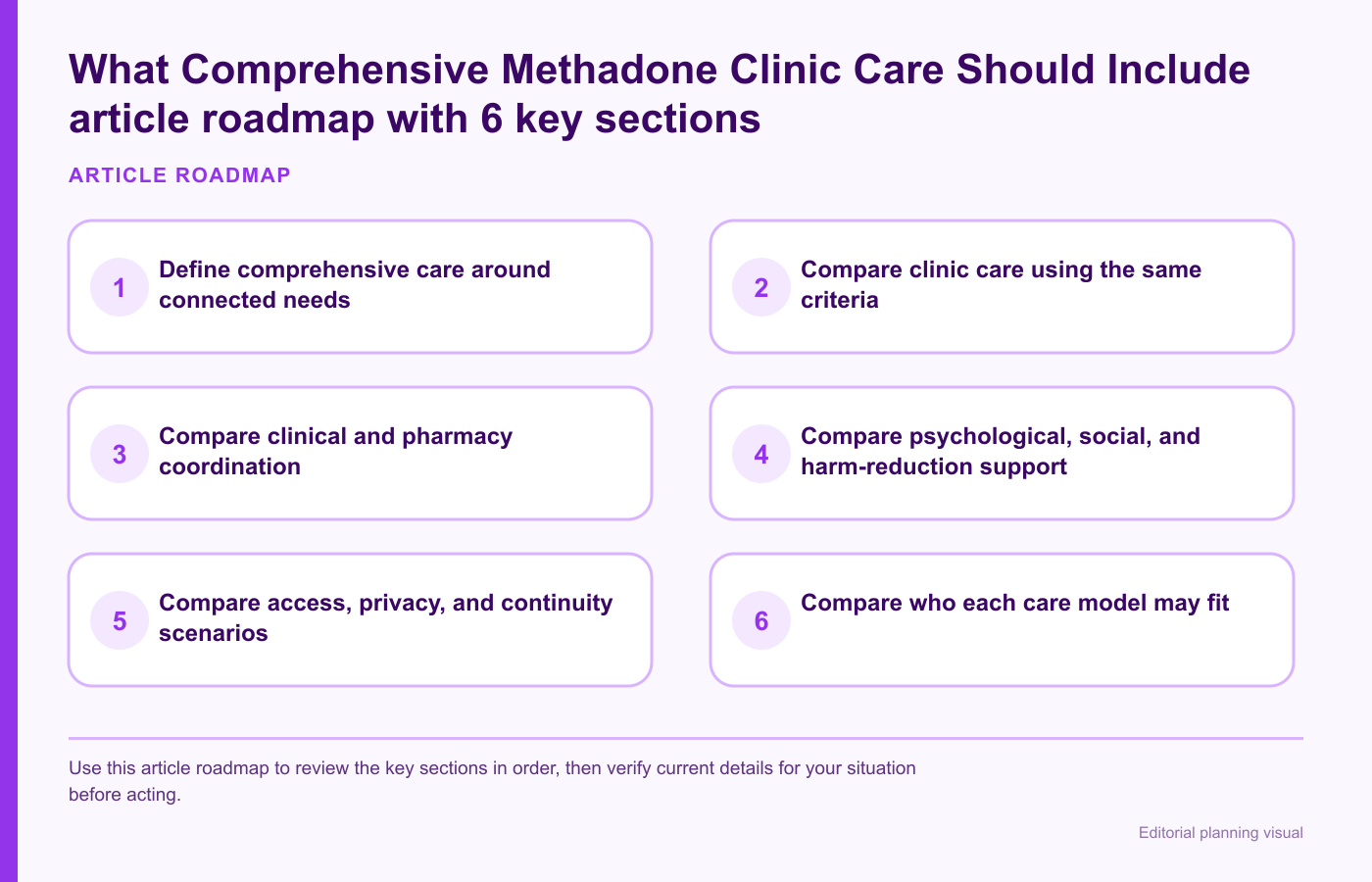
Compare clinical and pharmacy coordination
CPSO’s prescribing advice identifies OAT as first-line treatment for opioid use disorder and expects physicians to use current guidance, knowledge, skill, judgment, informed consent, and risk discussion. Ask who the prescriber is, how follow-up happens, and how routine versus urgent clinical questions are handled.
Do not ask a clinic website for dosing or take-home instructions. Ask how the clinic and dispensing pharmacy communicate, what a patient should do when a schedule or pharmacy issue arises, and which instructions must come from the prescriber or pharmacist. Never share medication or change the plan independently.
Road To Recovery publishes a Methadone Program page and broader OAT information. Those pages establish a service pathway, not personal eligibility or identical services at every location.
Compare psychological, social, and harm-reduction support
Health Canada’s substance-use treatment overview describes treatment as individualized and potentially combining medication, psychological support, peer support, harm reduction, health care, and social services. Ask which supports are on site, scheduled, optional, externally referred, or unavailable.
Relevant questions can include mental-health assessment, trauma-informed care, family resources with patient consent, housing or income referrals, primary-care connections, peer support, naloxone access, and culturally safe services. A referral name is not the same as a completed handoff; ask who initiates it, how long follow-up typically takes without expecting a guarantee, and what happens while waiting.
Compare access, privacy, and continuity scenarios
Review the Road To Recovery locations directory, then confirm which site provides the needed assessment and follow-up. Ask about physical accessibility, language or communication needs, appointment formats, transportation, childcare constraints, work hours, privacy at phone or email contact, and the process for changing locations.
Test the pathway with real scenarios: What if the patient is hospitalized? What if a phone number changes? What if they need to travel? What if they miss an appointment or pharmacy visit? What if their substance use, health, pregnancy status, medications, housing, or safety changes? The clinic should direct each scenario to the appropriate clinician or service, not offer a one-size-fits-all promise.
Compare who each care model may fit
A clinic with on-site prescribing and strong pharmacy coordination may suit someone who wants fewer handoffs, while a model that connects several community providers may suit someone who already has trusted primary care, counselling, or social supports. Neither model is automatically more comprehensive. Ask whether those connections are active, timely, consent-based, and accountable.
Someone with transportation, mobility, work, childcare, language, or privacy constraints may prioritize a reachable location and clear communication. Someone with overlapping mental-health, housing, health, or family needs may prioritize coordinated referrals. A person transferring from another program may need an especially clear records and continuity process. These are fit scenarios for discussion, not clinical recommendations.
Compare the burden placed on the patient. Count separate appointments, travel, phone calls, forms, pharmacy steps, and referral follow-ups. Then ask which responsibilities the clinic takes on and which remain with the patient or another provider. A transparent program should identify gaps before care begins and explain how reassessment happens when the initial arrangement stops fitting.
Ask these decision-ready questions
- Which services are provided directly at this location?
- Who completes the assessment and prescribing follow-up?
- How is the dispensing pharmacy selected and contacted?
- What counselling, mental-health, peer, family, and social supports are available or referred?
- What is the routine, urgent, and emergency contact plan?
- How are privacy, consent, records, and family involvement handled?
- What happens if needs, location, pharmacy, or availability change?
- What costs, coverage, identification, or referral details must be confirmed before intake?
Common comparison mistakes and red flags
- Choosing only by distance without confirming the needed service.
- Treating methadone access as the entire care plan.
- Accepting guaranteed recovery, abstinence, safety, or take-home eligibility claims.
- Relying on online dosing, tapering, or missed-dose advice.
- Assuming counselling, mental-health care, or pharmacy coordination is included.
- Ignoring privacy and consent questions.
- Leaving without routine, urgent, and emergency instructions.
- Assuming all Road To Recovery locations have identical staff, hours, and programs.
Frequently asked questions
Is methadone the right option for everyone?
No. A qualified clinician must assess options, risks, preferences, and current circumstances.
Does comprehensive care require every service in one building?
No. What matters is whether needed services are available and coordinated, with clear referrals and follow-up.
Can a family member join the discussion?
That depends on the patient’s wishes, consent, privacy rules, and clinical context. Ask the clinic how involvement is handled.
Does Road To Recovery offer the same program everywhere?
This article does not claim that. Confirm the exact location, intake, hours, clinician, and service scope.
Contact the clinic with a service-comparison checklist
Use Road To Recovery’s Methadone Program page and contact route to confirm the location-specific pathway. Bring the questions above to an individualized assessment. Do not change medication from this article. Clinical and legal review are mandatory before publication.