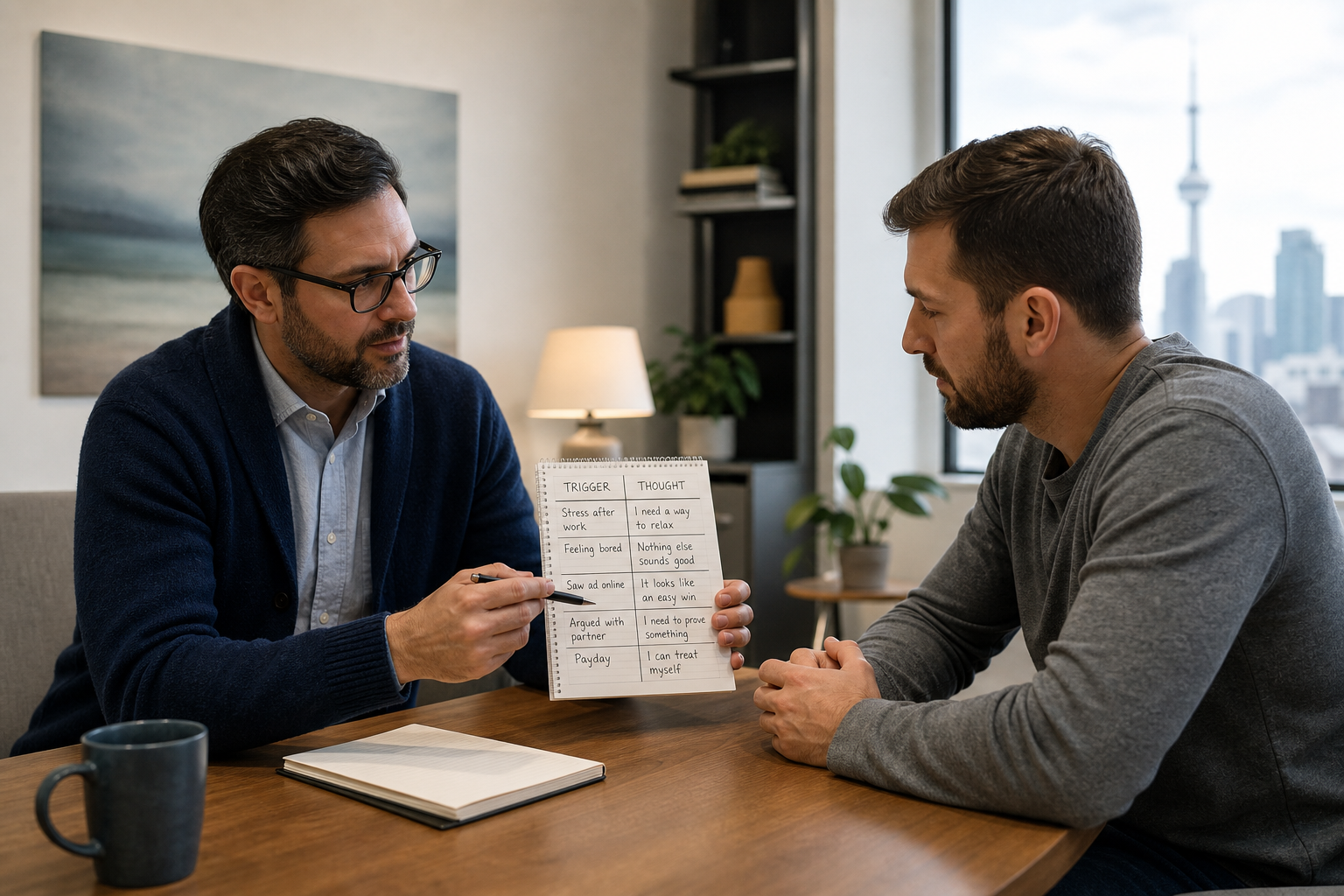
Cognitive behavioral therapy (CBT) for gambling addiction helps people examine the thoughts, emotions, situations, and habits that keep harmful gambling going. Instead of relying on willpower alone, CBT teaches practical ways to question gambling beliefs, recognize triggers, delay action, and practise a safer response.
These exercises are educational examples, not a diagnosis or a substitute for individualized assessment. If gambling is affecting your finances, relationships, work, or mental health, professional support can help you choose strategies suited to your circumstances.
Quick summary
 271-8425d4/fbb89e92-06e1-4837-b753-7c96f839dcf5.png)
- Common CBT targets include chasing losses, gambler’s fallacy, illusion of control, near-win thinking, and urges linked to stress, boredom, or easy access.
- A useful exercise is to record the trigger, gambling thought, evidence, likely consequence, and alternative action.
- CBT is often paired with safeguards such as self-exclusion, money boundaries, access restrictions, and accountability.
- Outpatient gambling treatment may combine counselling, trigger management, relapse planning, and mental health support.
What CBT means in gambling addiction treatment
CBT examines the connection between what happens, what you think about it, how you feel, and what you do next. A sports event, payday, difficult emotion, or unexpected win may activate a thought such as, “I can recover what I lost.” That thought can increase urgency and lead to another bet.
The goal is not simply to eliminate every urge. It is to notice the pattern earlier, test whether the thought is reliable, and create enough distance to choose a different response. Repeated practice can make safer responses easier to access, although no technique guarantees a particular outcome.
Core gambling addiction CBT techniques
 271-8425d4/31e1a023-b00c-47e9-9627-c57662437550.png)
The examples below show how CBT techniques can be applied to common gambling situations. They are general illustrations, not conclusions about any particular person.
| Technique | Possible thought or trigger | CBT question | Safer response to consider |
|---|---|---|---|
| Cognitive restructuring | “I am due for a win after losing several times.” | What evidence shows that past results control the next result? | Pause, write a balanced response, and do not use another bet to solve the loss. |
| Trigger mapping | Payday, a sports event, late night, stress, or boredom | What happened before the urge, and where did access become easy? | Plan a different activity and reduce access before the high-risk period. |
| Urge delay | “I have to place this bet immediately.” | Can I wait while the urge changes? | Leave the betting environment and contact someone. |
| Behavioural planning | Unstructured evenings or stress | What action can replace the gambling routine? | Schedule exercise, a meal, a call, or another planned activity. |
| Relapse planning | “I have already failed, so I may as well continue.” | What is the next helpful step? | Stop the sequence, record the trigger, and review safeguards. |
1. Challenging gambling distortions
Cognitive restructuring, sometimes described as challenging gambling distortions, means identifying a gambling belief and testing it rather than treating it as fact. The purpose is to create a more accurate description of the situation before acting.
Examples include chasing losses, gambler’s fallacy, illusion of control, “due win” beliefs, and near-win thinking. Chasing losses treats another bet as a way to repair the previous result. Gambler’s fallacy assumes an outcome becomes more likely simply because it has not happened recently. Illusion of control can overestimate the effect of rituals, timing, or skill in a random outcome.
- Name the thought: Write the exact sentence in your mind, such as “I can win it back tonight.”
- Examine the evidence: Ask what supports the thought and what contradicts it.
- Name the risk: Consider further loss, secrecy, or increased urgency.
- Write a balanced response: For example, “Another bet may increase the loss. I can pause and protect my essential money.”
2. Mapping triggers before an urge becomes a bet
Trigger mapping identifies the pattern before it reaches the point of action. Record the situation, emotion, thought, access point, action, and result. Possible risk situations include late nights, payday, sports events, alcohol use, boredom, loneliness, anxiety, or easy access to an app.
A simple record might say: “After work, I felt discouraged. I thought betting would give me something to look forward to. The app was already open.” The next question is, “What could I change before this sequence reaches the deposit step?”
3. Replacing the gambling routine with a planned response
Behavioural planning turns an intention into a specific action. Decide in advance what you will do when an urge appears, because making decisions during intense emotion can be difficult.
A plan might include delaying the decision, leaving the betting environment, closing or blocking access where possible, contacting an accountability person, and moving to a scheduled activity. For a high-risk evening, you could arrange dinner with someone, attend a regular activity, keep your phone away, and send a check-in message afterward.
The replacement activity does not need to feel as exciting as gambling. Its first purpose is to create time and distance. Once the immediate urge has reduced, you can review the thought and decide what additional support is needed.
4. Combining CBT with safeguards and relapse planning
Thought exercises work best when the environment supports the decision you are trying to make. General safeguards may include self-exclusion, account or device restrictions, limiting access to discretionary funds, separating money needed for essentials, and asking a trusted person to help review a plan.
These are options to evaluate for your situation, not services that every clinic provides. Financial boundaries should not put rent, food, medication, transportation, or other essentials at risk. If debt is involved, consider financial advice alongside addiction support.
Relapse planning is not a promise that a lapse will never occur. It is a written response for what to do if gambling happens: stop as soon as possible, avoid trying to win back the loss, record what preceded it, contact support, and adjust the plan. Readers who want to apply these skills over time can explore gambling recovery, including CBT work on gambling beliefs and replacement routines.
A CBT checklist to use after a gambling urge
- Identify the thought: What am I telling myself about this bet, win, loss, or opportunity?
- Name the trigger: What happened just before the urge?
- Test the belief: What evidence supports it, and what thinking error might be present?
- Choose a replacement action: What can move me away from betting?
- Add a safeguard: Can I close access, protect essential money, or ask for help?
- Contact support: Who can hear what is happening without helping me hide it?
- Review what happened: What worked, and what should change next time?
If urges remain difficult to manage or gambling is causing significant harm, use this checklist to prepare for a professional conversation rather than treating it as a complete treatment plan.
How outpatient gambling treatment may fit in Ontario
Outpatient care can provide structured support while you continue with parts of your usual routine. Depending on the provider and assessment, care may include confidential counselling, trigger management, behavioural planning, relapse planning, and assessment of overlapping mental health or substance-use concerns.
Road To Recovery describes its Gambling Addiction Treatment Program as combining clinical support and counselling to help people reduce or stop harmful gambling behaviours in a safe, structured, and sustainable way. Its Ontario clinics provide confidential outpatient addiction treatment, but the available evidence does not establish a specific CBT protocol, appointment schedule, or guaranteed result.
Mental health support may also be relevant when gambling occurs alongside anxiety, depression, substance use, or other concerns. Ontario provides confidential connections to mental health and addiction services, including cognitive behavioural therapy through the Ontario Structured Psychotherapy Program for eligible adults. Review the province’s mental health and addiction service options to understand possible pathways.
When to seek professional support
Consider requesting an assessment if you have repeatedly tried to stop, are chasing losses, hiding gambling, borrowing or using essential money, or experiencing conflict at home or work because of betting. You do not need to wait until the situation becomes worse.
Professional support is especially worth considering when gambling overlaps with alcohol or drug use, sleep problems, intense distress, or other mental health concerns. A clinician can help prioritize concerns and develop a plan more individualized than a general worksheet.
Frequently asked questions
Can CBT help with chasing gambling losses?
CBT can help you examine the belief that another bet will repair a previous loss and build a delay plan with practical safeguards. It cannot guarantee that losses will be recovered or that urges will disappear.
What should I write down when a gambling urge starts?
Record the time, situation, emotion, exact gambling thought, access point, action you are considering, and likely consequence. Then write one balanced response and one alternative action.
Can outpatient gambling treatment include mental health support in Ontario?
It may, depending on the provider and your needs. Road To Recovery states that psychiatry referrals can be coordinated locally or virtually through CAMH and OTN partners. Ontario also lists confidential mental health and addiction service connections.
Conclusion: CBT turns gambling urges into choices you can examine
Gambling addiction CBT techniques focus on practical change: identify the thought, map the trigger, test the belief, delay the action, and plan a safer response. Access limits, money boundaries, accountability, and a written lapse plan can make those choices easier to carry out.
If gambling is affecting your wellbeing or relationships, confidential outpatient counselling and coordinated mental health support may be a more suitable next step than trying to manage the pattern alone. For information about its Gambling Addiction Treatment Program and outpatient services across Ontario, visit Road To Recovery.




You are Valued
Road to Recovery is an outpatient opioid detoxification center, with locations across Ontario.
- Confidential care
- Same-day support
- Personalized treatment