
A Canadian, clinician-led orientation to extended-release buprenorphine care
Short answer. SUBLOCADE is a prescription, extended-release buprenorphine product used within a complete clinician-led plan for opioid use disorder in adults. In Canada, it is administered only by a health-care professional as a subcutaneous injection. It is not handed to a patient for self-injection. A qualified clinician must decide whether it is appropriate, plan any transition, review medicines and substance use, administer it, and arrange follow-up.

This is a question-and-safety guide, not an eligibility decision, dosing schedule or injection procedure.
Know when SUBLOCADE questions become an emergency
Call 911 for suspected overdose, severe trouble breathing, loss of consciousness or another immediate emergency. Health Canada’s opioid overdose guidance says to call 911, give naloxone if available, stay with the person and follow emergency instructions. Naloxone can wear off while opioids remain active, so emergency assessment is still necessary even if the person wakes.
Keep the product information and care-team contact route available, but do not delay emergency care to identify the exact cause. A person may have taken more than one substance, and a long-acting medication changes what clinicians need to know. Tell emergency responders about known medications, alcohol or other substances when it is safe to do so.
Questions about routine symptoms, an appointment, a delayed visit or treatment preferences belong with the prescribing care team. The team can decide whether the situation requires urgent assessment; a blog cannot triage an individual.
Understand what SUBLOCADE is and what this guide does not do
The current Canadian Health Canada Drug Product Database entry lists SUBLOCADE as a marketed, extended-release, subcutaneous prescription product with controlled distribution. The linked Canadian product monograph states that it is indicated for management of moderate to severe opioid use disorder in adults and should be part of a complete treatment plan.
A complete plan can involve clinical follow-up and psychosocial or other supports based on individual needs. Medication is not a moral test, and seeking information does not commit someone to a particular treatment. Health Canada’s opioid use disorder treatment overview describes opioid agonist therapies and the value of discussing options with a health professional.
This article does not provide a dose, injection schedule, transition timing, eligibility rule, effectiveness prediction or personal recommendation. Those details require current product information and an individual clinical assessment.
Prepare a complete picture for the clinical visit
The care team needs accurate information, not the answer someone thinks will “qualify.” Before the appointment, write down prescribed and non-prescribed medicines, over-the-counter and natural products, alcohol, cannabis and other substance use. Include recent changes, allergies, past reactions and the pharmacy used. Bring medication containers or a current pharmacy list if the clinic requests them.
Also prepare medical and care context: current opioid treatment, recent opioid use, overdose history, breathing or sleep concerns, liver or other health conditions, pregnancy or breastfeeding considerations, mental health care, planned surgery or dental work, pain needs, and barriers to follow-up. Do not change or stop a medication to make the list simpler.
| Prepare | Why the clinician may need it |
|---|---|
| Complete medicine and substance list | To assess interactions, sedation and treatment safety |
| Current treatment and recent use | To plan care without guessing at the starting point |
| Health conditions and past reactions | To identify individual risks and monitoring needs |
| Upcoming procedures and pain plan | To coordinate with other health professionals |
| Goals, concerns and practical barriers | To build a plan the patient can understand and follow |
Ask how privacy, records and communication with other providers will work. Bring a trusted support person only if the patient wants that involvement and the clinic permits it.
Let a qualified clinician determine whether the treatment fits
SUBLOCADE is not chosen from a checklist alone. The clinician reviews diagnosis, current treatment, medicine and substance use, medical risks, patient goals, product requirements, ability to attend follow-up and available alternatives. The clinician may need information, examination or tests that a web page cannot replace.
Useful questions include:
- What problem is this option intended to address in my care plan?
- What alternatives should I understand, including staying with my current plan?
- What needs to happen before a first administration?
- Which benefits and risks matter most in my situation?
- What follow-up, monitoring and support are expected?
- Whom do I contact after hours or in an urgent but non-emergency situation?
- How would future pain treatment, surgery, travel or pregnancy planning be handled?
A clinician’s decision may change as information changes. Do not borrow another person’s plan or use an online story as evidence that the same choice will fit.
Respect the administration and handling boundaries
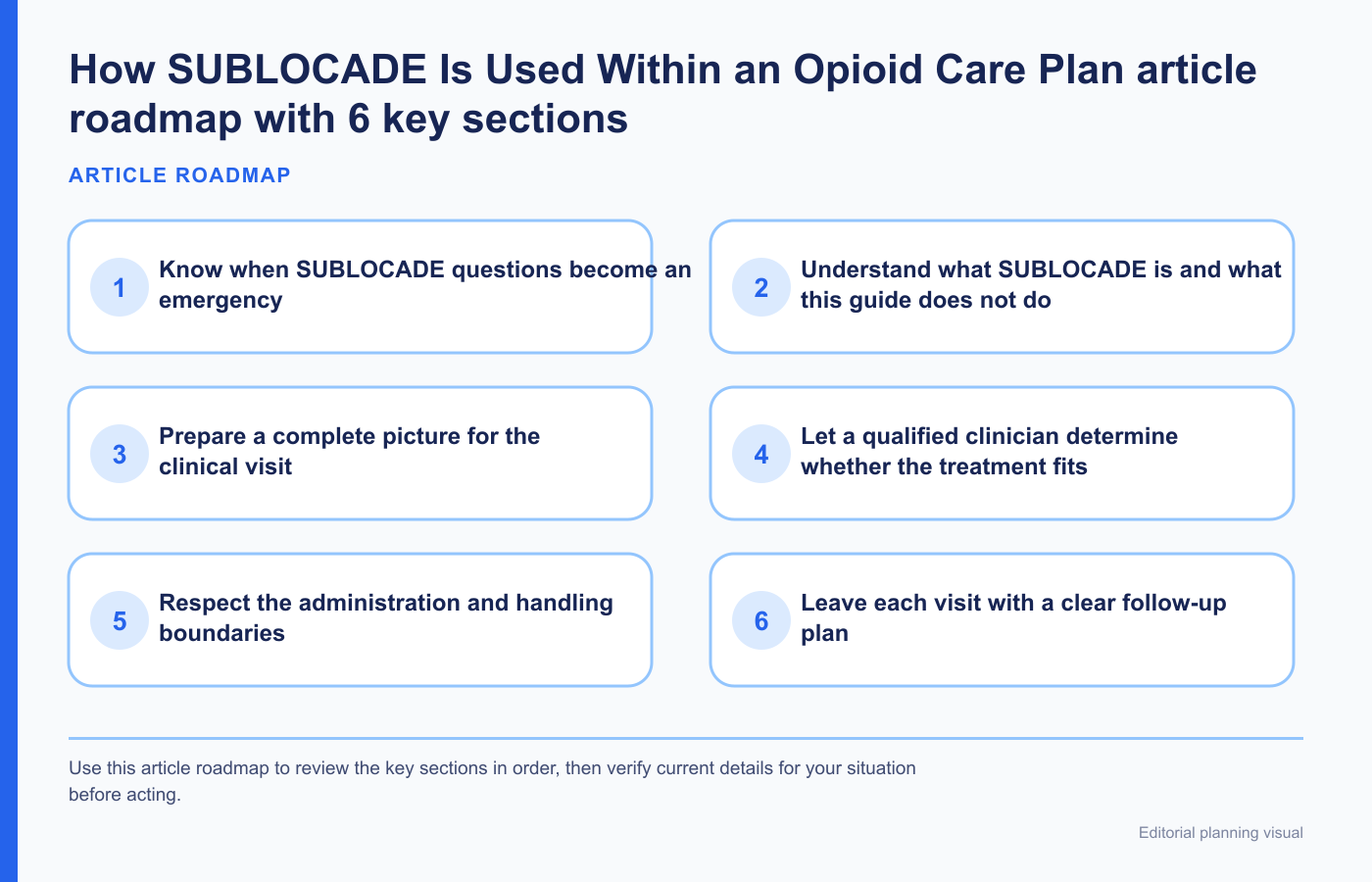
The safe action for patients is to prepare, ask, disclose and follow up—not to reproduce a clinical procedure.
The current Canadian SUBLOCADE product monograph says the product is for subcutaneous administration only by a health-care professional. It must not be given to a patient to take home or self-administer. Administration through the wrong route can cause serious harm.
For that reason, this guide intentionally does not describe injection technique, preparation, anatomy, equipment, storage handling or a dosing schedule. Patients should use the authorized clinic and pharmacy pathway, follow the care team’s appointment instructions and ask what identification, records or medication information to bring.
After administration, follow the care team’s written instructions about the injection area, expected monitoring and when to seek help. Do not press, cut, massage, remove or otherwise manipulate a deposit under the skin unless a qualified clinician specifically directs care. Report concerning symptoms through the instructed route.
Leave each visit with a clear follow-up plan
Before leaving, confirm the next contact or visit, how reminders work, the clinic’s urgent-question route, what symptoms need prompt assessment, and how routine care connects with counselling or other supports when part of the plan. Ask for written information that matches the current Canadian monograph.
Use a simple care record:
- Record the visit date and care-team contact route.
- Keep the current medicine and substance list updated.
- Write down symptoms or concerns with timing and context.
- Record upcoming medical, dental or travel needs.
- Bring questions to the next appointment rather than changing the plan alone.
Road To Recovery’s resource area may provide a starting point for its currently published patient information. Verify the current page date and discuss medication details with the care team because older website copy can conflict with newer authorized product information.
Contact the care team about delayed visits, stopping or changing treatment
Do not create a replacement schedule from memory or another patient’s instructions. If an appointment may be missed or delayed, contact the care team as early as possible. Tell them when the last visit occurred, what changed and whether there are new medicines, opioid use, symptoms or access barriers. The clinician decides the next safe step.
SUBLOCADE is extended-release, so treatment considerations can continue after a visit and after someone wants to stop. Do not assume that missing a visit means the medication has immediately left the body. Ask how ongoing monitoring, pain treatment, interactions and future care should be managed.
If changing clinics, request a safe records-transfer process and clarify which clinician is responsible during the handoff. Do not rely on verbal recollection for product, visit or medication details.
Discuss alcohol, sedatives, pain care and every other medicine
The Canadian product monograph warns that combining buprenorphine with benzodiazepines, alcohol or other central nervous system depressants can cause severe sedation, respiratory depression, coma and death. That is a reason for honest disclosure and coordinated care, not for abruptly stopping a prescribed medicine without direction.
Tell the prescriber and other treating professionals about SUBLOCADE before surgery, dental procedures, emergency treatment or a new medicine. Ask how pain will be managed and which provider will coordinate the plan. Keep emergency information accessible if the care team recommends it.
The U.S. Food and Drug Administration’s medications for opioid use disorder overview provides useful general context, but FDA information applies to the United States. In Canada, the current Health Canada authorization and Canadian product monograph control product-specific use.
Build an overdose safety plan around the whole household
Ask a health professional or pharmacist how to obtain and use naloxone in the applicable province or territory. People likely to be nearby should know where it is, how to recognize an overdose, and that 911 is required. Check supplies and expiry information according to the product instructions.
Reduce preventable uncertainty by keeping medications secured, never sharing them, and making sure emergency responders can learn what was taken. Discuss reduced tolerance and return-to-use risk with the care team. A medication plan does not eliminate the risk created by fentanyl, unknown supply, alcohol or sedating combinations.
A written plan should name the emergency action, naloxone location, current medications, care-team contact and support person, while protecting privacy. Revisit it when medicines, living arrangements or care plans change.
Dangerous SUBLOCADE mistakes to avoid
- Trying to obtain, handle or inject SUBLOCADE outside the authorized health-care pathway
- Using a blog to choose a dose, schedule, transition or eligibility
- Hiding alcohol, benzodiazepine, sedative or other substance use from the clinician
- Stopping a prescribed medicine abruptly without clinical direction
- Waiting for a routine callback during overdose or severe breathing trouble
- Assuming naloxone removes the need to call 911
- Manipulating the injection area or deposit without care-team direction
- Forgetting to tell emergency, dental or surgical teams about long-acting buprenorphine
- Relying on older clinic copy when the current Canadian monograph differs
Frequently asked questions
Can I inject SUBLOCADE myself?
No. The current Canadian product monograph states that it is administered only by a health-care professional and must not be handed to the patient for self-administration.
Who decides whether SUBLOCADE is appropriate?
A qualified prescriber must assess the individual, current treatment, risks, goals, alternatives and product requirements. A keyword, quiz or article cannot determine suitability.
What should I do if I may miss an appointment?
Contact the care team promptly and follow its individual instructions. Do not make up a schedule or substitute another person’s advice.
Does SUBLOCADE prevent every opioid overdose?
No medication makes all opioid use risk-free. Keep an overdose response plan, naloxone access where appropriate and emergency instructions. Call 911 for suspected overdose.
Request a clinician-led discussion with Road To Recovery
Prepare your current medicine and substance list, treatment history, health information, goals and questions. Use Road To Recovery’s official website or its current patient question route to confirm available services, locations, intake steps, prescriber access, cost or coverage process and urgent-care instructions. A qualified clinician must provide the final assessment and current product guidance.